How a battery explosion exposed the vulnerability of centralized government infrastructure and why decentralized identity solutions matter more than ever.
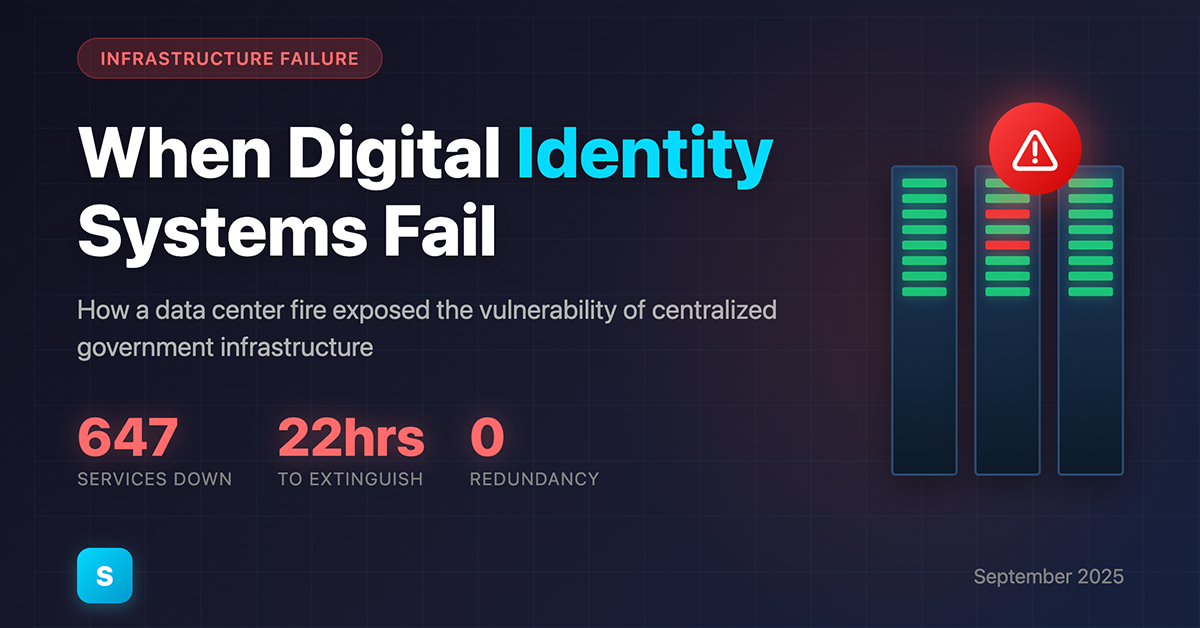
The Incident: A Single Point of Failure Brings Down 647 Government Services
On September 27, 2025, at 8:20 PM local time, a lithium-ion battery explosion at South Korea’s National Information Resources Service (NIRS) data center in Daejeon triggered a catastrophic fire that paralyzed hundreds of critical government services. What began as routine maintenance quickly escalated into one of the most significant digital infrastructure failures in the country’s history.
The fire left 647 online government services and systems down, including the mobile identification system, online postal service, tax facilities, and government email systems. For a nation that prides itself on being one of the world’s most digitally advanced, the outage was a wake-up call about the fragility of centralized digital infrastructure.
How the Fire Started: A Maintenance Procedure Gone Wrong
The disaster occurred during what should have been a routine safety procedure—relocating 384 uninterruptible power supply (UPS) battery packs from the fifth-floor server room to the basement. The batteries, which provide emergency backup power to prevent data loss during outages, had been flagged as a fire risk due to their proximity to critical servers—just 60 centimeters away.
The fire broke out approximately 40 minutes after staff cut power to begin moving the second group of batteries, when a UPS battery suddenly sparked. This ignition triggered what officials described as a “thermal runaway”—a chain reaction releasing extreme heat that made the fire exceptionally difficult to contain.
The blaze destroyed nearly 200 lithium-ion battery packs and required 170 firefighters and 63 fire trucks to combat. Because applying large volumes of water could damage critical government data, firefighters had to rely primarily on carbon dioxide suppression systems, which significantly slowed the response. It took 22 hours to fully extinguish the fire.
The batteries themselves were past their prime. Manufactured by LG Energy Solution and installed in August 2014, they had exceeded their recommended 10-year lifespan by a year, though they had passed regular inspections. The batteries’ warranty had expired in 2024, and LG CNS had advised replacement during a June 2024 checkup, though they remained functional.
Why Services Went Offline: The Absence of Redundancy
The scale and duration of the outage stemmed from a critical architectural flaw: the lack of a functional redundancy system that could immediately take over operations when the primary data center failed.
While NIRS claimed to have data backed up at two regional branches outside Daejeon headquarters, there was no emergency system in place to handle backup data and restore services. The government had touted systems capable of restoring online services within three hours during disasters, but this proved to be an exaggeration.
Prime Minister Kim Min-seok acknowledged this fundamental weakness, stating there were “difficulties in containing the fire because of the nature of critical government systems being concentrated at one site”. President Lee Jae Myung was more direct during an emergency Cabinet meeting, calling the lack of backup systems “shocking” and noting that “there was supposed to be a backup system to immediately take over operations when the data center goes down due to a disaster like this, but such a system doesn’t exist”.
The architecture failure was particularly striking given South Korea’s recent history. In 2022, a fire at a KakaoTalk data center disrupted messaging services for days, with Kakao heavily criticized for lacking proper backup systems. Despite this painful lesson, the national government had failed to implement the same redundancy that they had criticized the private sector for lacking.
Data center experts identify several levels of redundancy—N+1, 2N, and 2N+1 configurations—that protect against single points of failure. President Lee announced that the goal moving forward would be a dual-system architecture for critical processes, but this infrastructure should have existed before the crisis.
The Ripple Effects: When Digital Identity Becomes a Single Point of Failure
The fire’s impact extended far beyond administrative inconvenience. The mobile ID system went offline, with Prime Minister Kim warning that airport travelers who depend solely on mobile IDs could face disruption. The outage affected discount verification for bus and rail tickets, post office debit card payments, and mobile ID checks at airports.
Immigration officials struggled to properly screen incoming foreign visitors, raising concerns about the ability to identify criminals or potential security threats. The timing was particularly problematic, as it coincided with the start of a visa-free entry program for Chinese group tourists.
By September 29, authorities had restored only 62 of the approximately 647 affected systems—less than ten percent. Experts noted that the outage suggested the government lacked adequate systems for immediate recovery of critical public services, despite major tech disruptions in recent years.
The Systemic Risk of Centralized Digital Identity
The NIRS fire illuminates a broader vulnerability facing governments worldwide as they rush to digitize citizen services: the concentration of critical identity infrastructure creates catastrophic single points of failure.
When identity verification becomes centralized, the benefits are clear—streamlined access, administrative efficiency, and simplified user experience. However, the risks scale exponentially. A centralized digital identity system creates what security experts call an “identity chokepoint”—when it fails, everything dependent on it fails simultaneously.
The consequences extend beyond temporary inconvenience:
Loss of Essential Services: Citizens cannot access healthcare records, receive government benefits, or complete time-sensitive transactions. Businesses cannot verify employees or customers. Border security becomes compromised.
Economic Disruption: The fire affected agencies ranging from police and fire to customs authorities, with the safety ministry’s own website among those out of service. When identity infrastructure fails, commerce grinds to a halt.
Security Vulnerabilities: Without functional identity verification, systems designed to prevent fraud and ensure security become inoperable. The gap between when services go down and when they’re restored creates windows of opportunity for malicious actors.
Cascade Failures: Modern digital governance relies on interconnected systems. When identity infrastructure fails, it triggers a domino effect across numerous dependent services that may not have been immediately obvious in the system design.
The South Korean incident demonstrates that even well-maintained, highly-funded centralized systems remain vulnerable to physical failures. As President Lee noted, “A single battery room must not become a single point of failure for a digital state”.
Why Decentralized Identity Matters in Crisis Scenarios
The fundamental issue with centralized identity systems is architectural: they concentrate risk rather than distribute it. When everything depends on a single infrastructure point, that point becomes both a vulnerability and a target.
Decentralized identity solutions offer a fundamentally different approach. Instead of storing all identity data and verification capabilities in one location, decentralized systems distribute identity across a network, allowing verification to occur without dependence on a single server, database, or facility.
Key advantages in emergency scenarios:
No Single Point of Failure: When identity verification doesn’t depend on a single data center, a fire, cyberattack, or equipment failure at one location doesn’t cascade into total system failure. Users retain the ability to prove their identity even when infrastructure goes offline.
Resilience During Disasters: Natural disasters, equipment failures, and human errors are inevitable. Decentralized systems are designed to operate even when parts of the network are compromised or offline.
User Autonomy: Rather than requiring connection to centralized servers for identity verification, decentralized systems allow individuals to control and present their credentials directly, without intermediary infrastructure.
Faster Recovery: When identity data and verification mechanisms are distributed rather than centralized, recovery from localized incidents is dramatically faster—restoration doesn’t require rebuilding or resyncing massive centralized databases.
Geographic Distribution: Decentralized architectures inherently spread infrastructure across multiple physical locations, providing natural disaster resistance and reducing the impact of any single facility failure.
Lessons for Digital Infrastructure Design
The Daejeon fire offers clear lessons for any organization building or relying on digital identity infrastructure:
- True redundancy requires more than backups: Having data backed up is insufficient if there’s no active system ready to take over operations immediately.
- Physical infrastructure matters: Even the most sophisticated digital systems rely on physical components—power supplies, cooling systems, servers—that can fail catastrophically.
- Concentration equals vulnerability: Gathering critical systems in one location improves administrative efficiency but creates systemic risk.
- Testing recovery is not optional: Systems designed to work during emergencies must be regularly tested under realistic failure scenarios.
- Architecture decisions have political consequences: When digital identity systems fail, citizens lose access to essential services, creating both humanitarian and governance crises.
The Future of Resilient Identity Infrastructure
As governments and organizations worldwide continue digitizing citizen services, the South Korean data center fire serves as a critical case study in infrastructure vulnerability. The incident demonstrates that even technically advanced nations with significant resources can find their digital governance paralyzed by a single point of failure.
The path forward requires rethinking fundamental assumptions about identity infrastructure. Rather than building bigger, better-protected centralized systems—which remain vulnerable to catastrophic single-point failures—the future points toward distributed, decentralized architectures that are resilient by design.
SNAPPASS: Building Identity Infrastructure That Works When Others Fail
This is where solutions like SNAPPASS become essential. Unlike traditional centralized identity systems that create single points of failure, SNAPPASS leverages decentralized architecture to ensure identity verification remains functional even during infrastructure emergencies.
SNAPPASS is designed with resilience at its core:
- Distributed verification means no single server or data center failure can bring down the entire system
- User-controlled credentials eliminate dependence on constantly-available centralized infrastructure
- Cryptographic security ensures identity verification without requiring persistent connection to vulnerable central databases
- Offline capability allows identity operations to continue even when network infrastructure is compromised
When traditional identity systems go offline—whether from fires, cyberattacks, natural disasters, or infrastructure failures—decentralized solutions like SNAPPASS continue functioning. As digital services become more central to governance and daily life, this resilience isn’t a luxury—it’s a necessity.
The South Korean data center fire proved that centralized systems, no matter how well-funded or technically sophisticated, remain vulnerable to catastrophic single points of failure. The future of reliable identity infrastructure lies in decentralized solutions that distribute risk, enhance resilience, and ensure that citizens can access essential services even when parts of the system fail.
Ready to build identity infrastructure that works when it matters most? Learn more about how SNAPPASS is reimagining digital identity for a world that can’t afford single points of failure at andopen.co.kr.