Managing visitor access has become one of the most pressing challenges for modern organizations. From corporate offices to educational institutions, healthcare facilities to data centers, businesses struggle to balance security requirements with operational efficiency. The question isn’t whether to control visitor access—it’s how to do it effectively without creating bottlenecks, privacy concerns, or security vulnerabilities.
The Growing Complexity of Visitor Management
Today’s visitor management landscape is far more complex than simply maintaining a sign-in sheet at the front desk. Organizations must account for diverse visitor types—from prospective clients attending hour-long meetings to HVAC contractors working for days, accounting auditors needing month-long facility access, family members visiting employees, and temporary workers. Each category requires different access levels, durations, and security clearances.
The stakes are high. Two-thirds of organizations surveyed are required by statute or regulation to meet specific access control standards, with most of these standards including comprehensive visitor accounting. Beyond compliance, there are practical concerns: preventing unauthorized access, tracking who’s on-premises during emergencies, protecting sensitive areas, and maintaining detailed audit trails.
Key challenges facing visitor management systems include ensuring compatibility with existing infrastructure, achieving user adoption when interfaces aren’t intuitive, customizing solutions to fit specific organizational needs, and maintaining regular updates to stay ahead of evolving security threats.
Traditional Approaches and Their Limitations
Most organizations currently rely on several common methods for visitor access control, each with distinct trade-offs:
Paper Logbooks and Manual Sign-In
The simplest approach—visitors sign a physical ledger at reception—remains surprisingly common. While inexpensive and requiring no technology, this method offers minimal security. Paper logbooks sit in the open, accessible to anyone, and when visitors sign in, they trust organizations with personal information that can be exposed through a simple breach or misuse. There’s no way to verify identity, prevent unauthorized access, or quickly locate specific individuals during emergencies.
Keycard and Fob Systems
Organizations often issue temporary physical credentials to visitors. These systems integrate with existing access control infrastructure and provide better tracking than paper logs. However, they introduce significant operational overhead: cards must be physically distributed, collected, deactivated, and replaced when lost. More critically, traditional access control systems like keycards are vulnerable to theft and cloning, and unlike biometric systems, token-based access systems can’t verify who is entering—only that a credential was used, leaving room for fraud, tailgating, shared badges, and insider threats.
PIN Codes and Passwords
Some systems rely on numeric codes sent to visitors via email or SMS. While easy to distribute digitally, PIN codes share the fundamental weakness of all knowledge-based authentication: they can be easily shared, written down, or observed. Biometric systems minimize risks associated with password sharing, reuse, or phishing attacks that exploit weak passwords.
Basic QR Code Systems
Standard QR code access control has gained popularity for its convenience. Organizations can generate codes and distribute them electronically, eliminating the need for physical credentials. QR codes are cost-efficient, simple to use, and can link with gates and doors to determine which code holders can enter facilities.
However, traditional QR codes have a critical security flaw: although QR codes are convenient, they can be shared, which poses a security risk. A visitor can easily screenshot their QR code and send it to unauthorized individuals. Static QR codes are like photographs because they don’t change, and they lack critical security measures because they are nearly effortless to screenshot, forward, or otherwise share.
The Biometric Revolution in Access Control
Biometric technology for access control has emerged as a key trend, relying on unique identifiers like facial features, fingerprints, and iris scans to confirm identities. The appeal is clear: biometric traits cannot be shared, reducing risks associated with stolen or copied keycards, and biometric systems are inherently more secure because physical characteristics used are unique to individuals and cannot be easily forged, duplicated, or shared.
Major technology companies have embraced biometric access control. Since 2005, Google has deployed iris recognition solutions to secure data centers in Mountain View, Dallas, Iowa, and New York. Educational institutions have also adopted these technologies, with schools implementing systems that can track visitor paths through campus and use real-time insights into who is currently in buildings to translate to improved security and operational efficiency.
Yet traditional biometric deployments come with their own challenges. Dedicated biometric hardware—fingerprint scanners, iris readers, facial recognition terminals—requires significant upfront investment. Quality biometric solutions cost more, with 67% of IT professionals citing cost as the biggest reason for not adopting biometric authentication. There are also privacy concerns: biometric data is inherently personal, and if compromised in a data breach, cannot be reset or changed like a password, with misuse potentially having severe consequences for individuals’ privacy and security.
The Breakthrough: Biometric Data Embedded in QR Codes
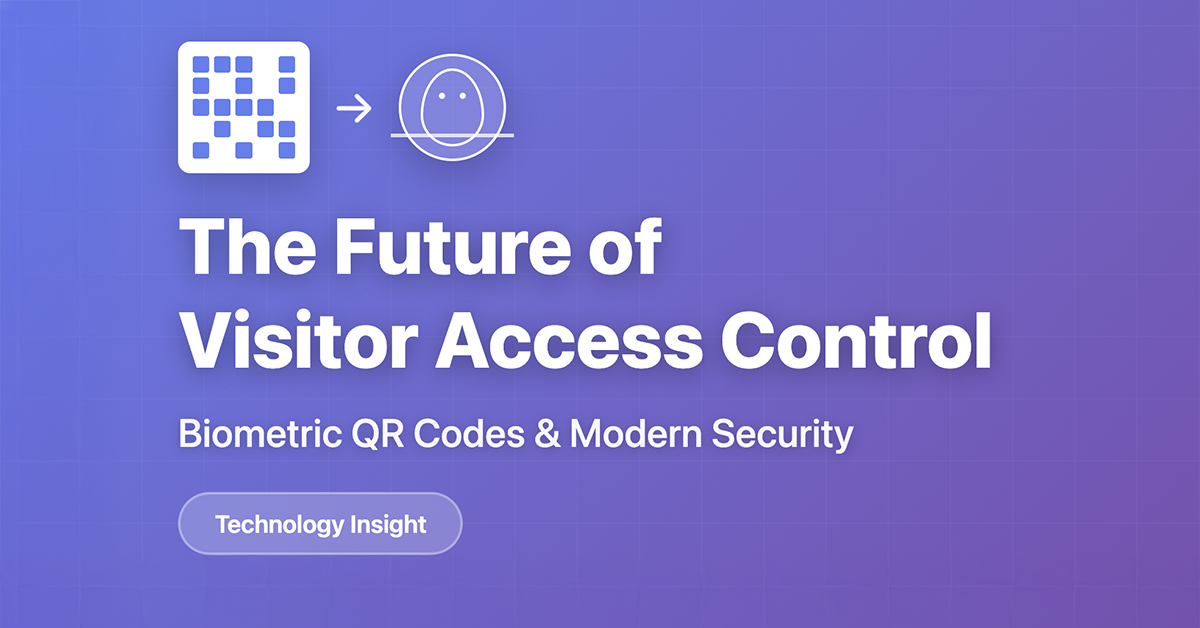
The next evolution in visitor access control combines the convenience of QR codes with the security of biometrics through an innovative approach: embedding biometric information directly within QR code tokens.
BioSeal technology can be embedded in QR codes and similar 2D barcodes, integrating biometric identity information such as fingerprint and facial data to provide multi-factor authentication capability. Similarly, advanced biometric QR codes integrate traditional QR codes with biometric data like facial recognition, employing two-factor authentication: “something you are” (biometrics) and “something you have” (the QR code), significantly increasing security and reducing unauthorized access risk.
This approach works by encoding a compressed biometric template—not a full photograph, but a mathematical representation of facial features—within the QR code itself. The personal data embedded in the code is not an image or directly identifiable information but a face vector derived from a 3D FaceMap that is minified and cannot be reverse-engineered or used by anyone else.
How Biometric QR Systems Work in Practice
The process is straightforward yet secure:
- Credential Generation: From a selfie or image of the user, the system transforms this information into a private, irreversible, non-interoperable, and revocable vector, which is then encrypted with additional user information and access permissions.
- Distribution: The QR code is sent to the visitor’s mobile device via email or can be stored in their digital wallet. It can be displayed on a smartphone or even printed for physical access.
- Verification at Access Point: At the door entry point, users present their QR code to a facial recognition terminal that scans both the QR code and the user’s face to match them. The system verifies that the QR code is valid and that the user has access rights, then checks the biometric data to confirm the user is the legitimate owner of the QR code.
- Access Decision: If both the credential and biometric match succeed, access is granted and the event is logged for security auditing.
Why This Method Solves Critical Security Problems
Preventing Credential Sharing
The most significant advantage is eliminating the shareability problem that plagues traditional access credentials. Unlike a keycard that can be handed to someone else or a standard QR code that can be screenshotted and forwarded, a biometric QR code is cryptographically bound to a specific individual. Even if someone obtains the QR code file, they cannot use it without presenting the correct biometric characteristics at the access point.
Enhanced Privacy Protection
Modern biometric QR implementations prioritize privacy by design. BioSeal is fully compliant with GDPR, ensuring all key data including biometric information is stored in the personal code with encryption, and local biometric authentication is performed on the Trusted End-Point, ensuring maximum privacy and security. The biometric template stored in the QR code is a one-way mathematical transformation—it cannot be reverse-engineered to reconstruct the original photograph.
Operational Simplicity
Organizations don’t need to maintain databases of visitor biometric information. The credential itself carries everything needed for verification. This decentralized approach reduces data breach risks while simplifying compliance with privacy regulations. Cloud-based visitor management systems offer scalable security, automatic compliance updates, built-in consent workflows, automated deletion rules, and encryption to protect against leaks and breaches.
Flexible and Revocable
QR codes can be effortlessly updated or revoked, allowing for dynamic adjustment of user access rights as needs change. If a visitor’s status changes or their appointment is cancelled, their credential can be immediately deactivated without requiring physical collection of a keycard.
Compatibility with Existing Infrastructure
Because these systems leverage standard QR code formats and can work with existing access control readers enhanced with camera capabilities, organizations can upgrade their visitor management without completely replacing their security infrastructure. Cloud-based systems integrate seamlessly with existing technologies like access control and video surveillance, creating a cohesive security ecosystem.
Industry Momentum and Standardization
The access control industry is rapidly moving toward these integrated solutions. Organizations are increasingly turning to unified security platforms that integrate access control, video surveillance, visitor management, and analytics into a single solution, simplifying security management by consolidating multiple systems into one interface.
Standardization efforts are also underway. MOSIP, the Modular Open Source Identity Platform, has introduced a standardized, interoperable QR code that enables offline authentication with face biometrics, intended to support cross-border interoperability among foundational and national ID systems. This push toward open standards ensures that biometric QR solutions from different vendors can work together, preventing vendor lock-in and promoting broader adoption.
The Path Forward: SNAPPASS and Modern Best Practices
As visitor access control continues to evolve, forward-thinking solutions like SNAPPASS are leading the charge by implementing these industry best practices. SNAPPASS’s SNAPIN QR code technology embodies the next generation of visitor management: combining the ease of distribution and scanning inherent to QR codes with the unshakeable security of biometric binding.
By storing full biometric credentials within compact, easily-distributed QR tokens, SNAPPASS addresses the core challenges that have plagued visitor management systems for years. Visitors enjoy a frictionless experience—no apps to download, no physical cards to carry, just a simple scan that proves their identity. Organizations gain ironclad security—credentials that can’t be shared, borrowed, or stolen, with comprehensive audit trails and real-time visibility into who’s on-premises.
Most importantly, SNAPPASS tackles the privacy concerns that have made many organizations hesitant to adopt biometric systems. With biometric data embedded in the visitor’s own credential rather than stored in centralized databases, and with cryptographic protections ensuring this data cannot be extracted or misused, the solution provides security without surveillance.
As access control technology continues advancing, the question is no longer whether to adopt biometric solutions, but which approach provides the right balance of security, privacy, convenience, and cost-effectiveness. The future of visitor access control isn’t just biometric—it’s biometric credentials that travel with the visitor, verifiable anywhere, shareable with no one but the person they belong to.