In September 2025, Korea’s second-largest telecommunications provider KT Corporation disclosed a sophisticated cyberattack that compromised 278 customers‘ mobile payment systems, resulting in ₩170 million ($122,400) in unauthorized transactions. While the financial losses appear relatively contained, the attack’s technical sophistication and novel methodology expose catastrophic vulnerabilities in the telecommunications-based authentication systems that billions rely on daily. This incident, occurring just months after SK Telecom’s breach affecting 27 million users, demonstrates that mobile phone-based authentication has become a systemic security liability that demands immediate replacement with decentralized alternatives.
KT’s femtocell attack represents a new threat vector
The KT incident marks the first documented case of illegal femtocell attacks in South Korea, introducing a frighteningly accessible attack vector that bypasses traditional security measures. Between August 6 and September 8, 2025, attackers deployed modified femtocells—small cellular base stations typically used to boost indoor coverage—to intercept and compromise user authentication processes.
The technical mechanism proved devastatingly effective. Attackers acquired standard femtocell devices for approximately ₩3 million ($2,200) through secondary markets, then modified the firmware to bypass carrier authentication protocols. Once connected to KT’s network, these rogue base stations automatically captured mobile devices within their 10-meter radius. When victims’ phones connected to what appeared to be the strongest available signal, the compromised femtocells intercepted 5,561 customers‘ IMSI (International Mobile Subscriber Identity) numbers and SMS authentication codes in plaintext after internal decryption.
KAIST Professor Kim Yong-dae explained the vulnerability: “While mobile communications are encrypted from phone to femtocell, the femtocell decrypts messages internally. If hackers control this femtocell, they can intercept messages and steal personal information in real-time.” The attackers concentrated their efforts in metropolitan Seoul and Gyeonggi Province, primarily during early morning hours when victims were unlikely to notice unauthorized transactions. They systematically drained accounts through mobile gift certificate purchases and transit card top-ups, exploiting KT’s micropayment system that relied solely on SMS verification for authentication.
What makes this attack particularly concerning is its accessibility. Unlike sophisticated nation-state operations requiring advanced persistent threats or zero-day exploits, the femtocell attack utilized readily available hardware and basic technical knowledge. Korea University Professor Lim Jong-in noted that if femtocells were compromised this easily, it suggests “potential internal control failures” and raises questions about insider involvement or inadequate security protocols for telecommunications equipment.
Korean telecoms face an epidemic of authentication breaches
The KT incident represents merely the latest chapter in South Korea’s ongoing telecommunications security crisis. The pattern of breaches reveals systemic vulnerabilities that have persisted for over a decade, with each incident exposing increasingly severe authentication weaknesses.
The April 2025 SK Telecom breach stands as potentially the most catastrophic telecommunications security failure in Korean history. Attackers maintained undetected access for nearly three years (June 2022 to April 2025), compromising the entire customer base of 27 million users. Using BPFDoor malware variants across 28 infected servers, threat actors—suspected to be Chinese APT groups including Red Mansion, Weaver Ant, and Salt Typhoon—extracted IMSI numbers, USIM authentication keys, and 25 categories of subscriber information. The breach’s sophistication and persistence prompted a ₩700 billion remediation investment and triggered nationwide security reviews.
Historical incidents reveal a troubling pattern. KT suffered major breaches in 2012 (8.7 million customers), 2014 (12 million customers, representing 75% of their user base), and 2016. LG U+ experienced a significant breach in 2023 affecting 300,000 customers, resulting in ₩6.8 billion in fines after investigators discovered database administrator passwords set to “admin” and inadequate access controls. The 2014 multi-operator breach simultaneously compromised all three major carriers—SKT, KT, and LG U+—affecting 12.3 million records total and demonstrating coordinated attacks across the entire industry.
These incidents share common characteristics: prolonged undetected access, exploitation of authentication system vulnerabilities, massive data exposure including authentication credentials, and delayed detection and reporting by telecommunications providers. The recurring nature across all major operators indicates that the problem extends beyond individual company failures to encompass industry-wide structural vulnerabilities in authentication architecture.
Mobile authentication systems contain inherent vulnerabilities
The technical architecture underlying mobile phone-based authentication creates multiple attack surfaces that sophisticated adversaries routinely exploit. At the core of these vulnerabilities lies the SS7 (Signaling System 7) protocol, a global telecommunications signaling standard from the 1970s that lacks authentication and encryption by design. The U.S. Department of Homeland Security assessment is stark: “DHS believes that all U.S. carriers are vulnerable to [SS7 and Diameter] exploits, resulting in risks to national security, the economy, and the Federal Government’s ability to reliably execute national essential functions.”
SS7 vulnerabilities enable devastating attacks including real-time location tracking, SMS interception of one-time passwords, call interception and eavesdropping, denial of service attacks, and subscriber fraud through billing manipulation. Access to SS7 networks, available for $150-$2,500 on dark web markets, provides attackers with capabilities previously reserved for intelligence agencies. The 2017 German banking attacks, where criminals drained accounts using SS7 vulnerabilities, demonstrated these aren’t theoretical risks but actively exploited weaknesses.
SIM swapping represents another critical vulnerability in mobile authentication. Princeton University research found that “four out of five SIM swap attempts in the United States are successful,” with 17 major websites including PayPal, Venmo, and Amazon remaining vulnerable to compromise through SIM swaps alone. The attack’s simplicity—social engineering carrier customer service to transfer a victim’s number to an attacker-controlled SIM—belies its effectiveness. In 2022, 40 KT customers lost ₩270 million in cryptocurrency through SIM swapping attacks, highlighting the direct financial impact.
Baseband processor exploits add another layer of vulnerability. These separate processors handling cellular communications are significantly less hardened than application processors, creating opportunities for remote code execution through malformed network packets. Security researchers at Mobile Pwn2Own demonstrated baseband compromises worth $100,000 bounties, proving that sophisticated attackers can bypass application-level security entirely through lower-level network access.
Korean-specific implementations compound these vulnerabilities. The 본인인증 (identity verification) system, mandatory for online services, integrates directly with telecommunications carriers and relies heavily on SMS verification. The micropayment system allows transactions up to ₩1 million monthly for adults, authenticated primarily through SMS codes and simple PINs. This over-reliance on telecommunications infrastructure for critical authentication creates cascading failure points when carriers are compromised.
Centralized authentication creates catastrophic single points of failure
The fundamental flaw in telecommunications-based authentication extends beyond technical vulnerabilities to architectural problems inherent in centralized systems. Academic research consistently identifies centralized authentication as creating dangerous single points of failure. As ACM Digital Library research notes: “The commonly used centralised trust and centralised identity management make information systems and organisations prone to a single point of failure.”
The Salt Typhoon campaign exemplifies how centralized telecommunications infrastructure becomes a strategic target for nation-state actors. This campaign, which Senator Mark Warner called the “worst telecom hack in our nation’s history” that makes “Colonial Pipeline and SolarWinds look like child’s play,” compromised at least nine U.S. telecommunications companies including Verizon, AT&T, and T-Mobile. Active for 1-2 years before detection, attackers accessed lawful intercept systems designed for government surveillance, creating ironically perfect attack vectors for foreign adversaries.
NIST’s official guidance explicitly acknowledges these risks. NIST SP 800-53 Control CP-8(2) states organizations should “obtain alternate telecommunications services to reduce the likelihood of sharing a single point of failure with primary telecommunications services.” The guidance recognizes that telecommunications providers often share physical infrastructure, multiplying vulnerability exposure across seemingly independent systems.
Industry analysis reveals consistent patterns in centralized system failures. When authentication depends on centralized infrastructure, server compromise impacts all connected systems simultaneously. Network outages create authentication failures across entire user populations. Database breaches expose credentials for millions of users at once, as demonstrated by the SKT incident’s 27 million victim count. Performance bottlenecks emerge when handling authentication requests at scale, creating both security and availability risks.
The contrast with decentralized systems is striking. IEEE research on distributed authentication notes: “Since authentication is spread out, the failure of one server does not affect all users. Systems can scale independently, handling more users or requests without overwhelming a central server. Compromising one server does not necessarily risk the entire network.” This architectural advantage isn’t theoretical—it’s the foundation for emerging authentication standards that eliminate telecommunications dependencies entirely.
Expert consensus demands abandoning SMS-based authentication
Security experts worldwide have reached overwhelming consensus: telecommunications-based authentication must be abandoned. Following the Salt Typhoon attacks, CISA issued unprecedented guidance explicitly recommending migration “away from SMS and voice messaging channels” and advising use of encrypted messaging apps instead of traditional telecommunications. This represents a fundamental shift in government position, acknowledging that SMS-based authentication cannot be secured adequately.
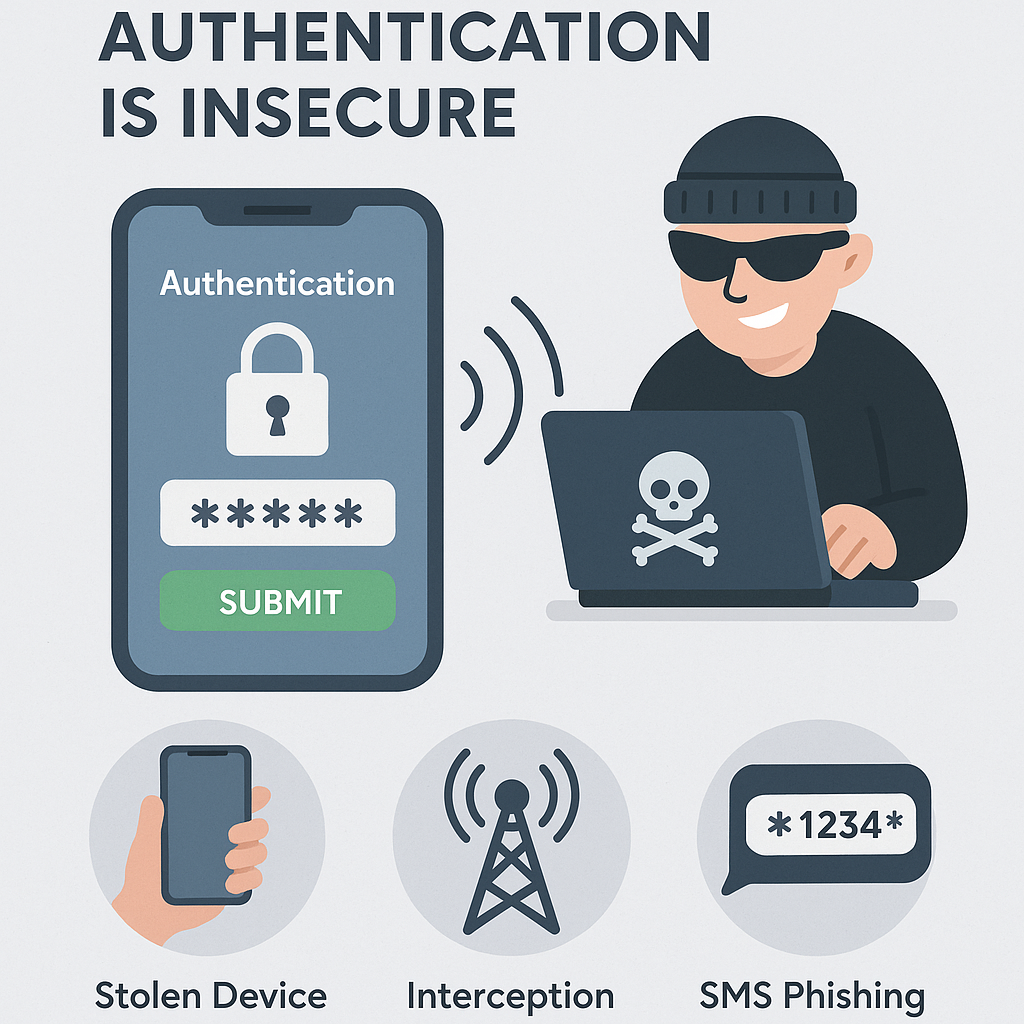
Bruce Schneier documented NIST’s attempted deprecation of SMS authentication, noting that while industry pressure forced a softening of the stance, “the underlying security concerns remain valid.” Research validates these concerns—Forrester found that “SMS 2FA stops only 76% of attacks,” leaving nearly a quarter of authentication attempts vulnerable to compromise.
The Princeton University study that reverse-engineered authentication policies across 140 websites provides empirical evidence of widespread vulnerability. Their finding that major platforms including PayPal and Amazon remain vulnerable to SIM swap attacks “in their default configuration” demonstrates that even sophisticated technology companies struggle to mitigate telecommunications-based authentication risks.
Financial industry experts sound particularly urgent warnings. Marcus Fowler, CEO of Darktrace Federal, explains: “The telecom sector is uniquely vulnerable to cyberattacks given the constant industry pressure to bring in new vendors… those added third-party vendors create a mounting security risk.” Ayan Halder from Traceable notes that “telecom-based attacks such as SMS toll fraud and 2FA hijacking have evolved into a mainstream concern for chief information security officers.”
Major technology companies are voting with their implementations. Microsoft has moved away from SMS-based 2FA entirely, promoting “passwordless technologies like Windows Hello for desktops or the Microsoft Authenticator app for mobile devices.” Google similarly deprecates SMS in favor of hardware security keys and app-based authentication. These shifts by industry leaders signal that SMS authentication has reached end-of-life status for security-conscious organizations.
Decentralized authentication eliminates telecommunications dependencies
The path forward requires fundamental architectural change—moving from centralized, telecommunications-dependent systems to decentralized, cryptographically-secured alternatives. ANDOPEN’s SNAPPASS represents one compelling approach, having won the 2025 CES Innovation Award for its network-free biometric authentication system.
SNAPPASS operates on a revolutionary principle: complete network independence. The system comprises SNAPPIN cards containing AI-optimized, encrypted biometric data that cannot be modified remotely, and SNAPCHECK authentication hardware featuring AI-powered deepfake and liveness detection. Authentication occurs entirely offline between the user’s card and the reader, processing up to 60 authentications per minute without any network connectivity. Biometric data never enters centralized databases and is immediately discarded after each authentication attempt.
This architecture addresses every major vulnerability in telecommunications-based systems. Without network transmission, there’s no possibility of SMS interception or SS7 attacks. Physical possession requirements prevent remote compromise. Local processing eliminates single points of failure. Distributed architecture ensures that compromising one location doesn’t affect others. The biometric component adds strong authentication that can’t be socially engineered or swapped like SIM cards.
The broader ecosystem of decentralized authentication solutions demonstrates market readiness for this transition. The decentralized identity market is experiencing explosive growth, from $647.80 million in 2022 to a projected $41.73 billion by 2030, representing up to 90.3% CAGR. Blockchain-based systems like Microsoft’s Entra Verified ID use W3C standard Decentralized Identifiers (DIDs) to give users control over their credentials. Hardware security keys following FIDO2/WebAuthn standards provide phishing-resistant authentication without telecommunications dependencies.
Academic research validates these approaches. Nature Scientific Reports published studies showing that blockchain-based authentication “leverages government-issued electronic identity cards to generate digital signatures and employs smart contracts to automate the authentication process,” eliminating telecommunications infrastructure requirements while maintaining security and usability.
The telecommunications authentication era must end now
The KT micropayments hack, while financially modest, represents a watershed moment in authentication security. The attack’s use of readily available femtocell hardware to compromise authentication systems demonstrates that telecommunications-based security has become trivially defeatable. When combined with the SK Telecom breach affecting 27 million users and persistent industry-wide vulnerabilities, the evidence becomes undeniable: telecommunications networks cannot be trusted for authentication.
The expert consensus is unanimous. Government agencies like CISA explicitly recommend abandoning SMS authentication. Academic research proves fundamental architectural flaws in centralized systems. Security researchers demonstrate successful attacks with frightening regularity. Major technology companies have already migrated away from telecommunications-dependent authentication. The question is no longer whether to abandon SMS and telecom-based authentication, but how quickly organizations can complete the transition.
Solutions like ANDOPEN’s SNAPPASS point toward a future where authentication operates independently of vulnerable telecommunications infrastructure. By combining physical possession, biometric verification, and network-free operation, these systems eliminate entire categories of attacks while providing superior user experience and privacy protection. The projected growth of the decentralized identity market to $41.73 billion by 2030 signals that enterprises recognize this imperative and are investing accordingly.
The KT incident should serve as the final warning. Organizations continuing to rely on SMS and telecommunications-based authentication accept catastrophic risks that extend beyond their individual security postures to threaten critical infrastructure and national security. The technology exists today to eliminate these vulnerabilities entirely. The only question remaining is whether organizations will act before becoming the next victim of an entirely preventable authentication breach.
For those seeking to learn more about transitioning to decentralized authentication systems, ANDOPEN’s SNAPPASS and similar network-free solutions offer immediate, implementable alternatives that address the root causes of telecommunications authentication failures. The time for incremental improvements has passed—the future of authentication must be decentralized, network-independent, and cryptographically secured. The KT hack has shown us the consequences of delay. The path forward is clear.