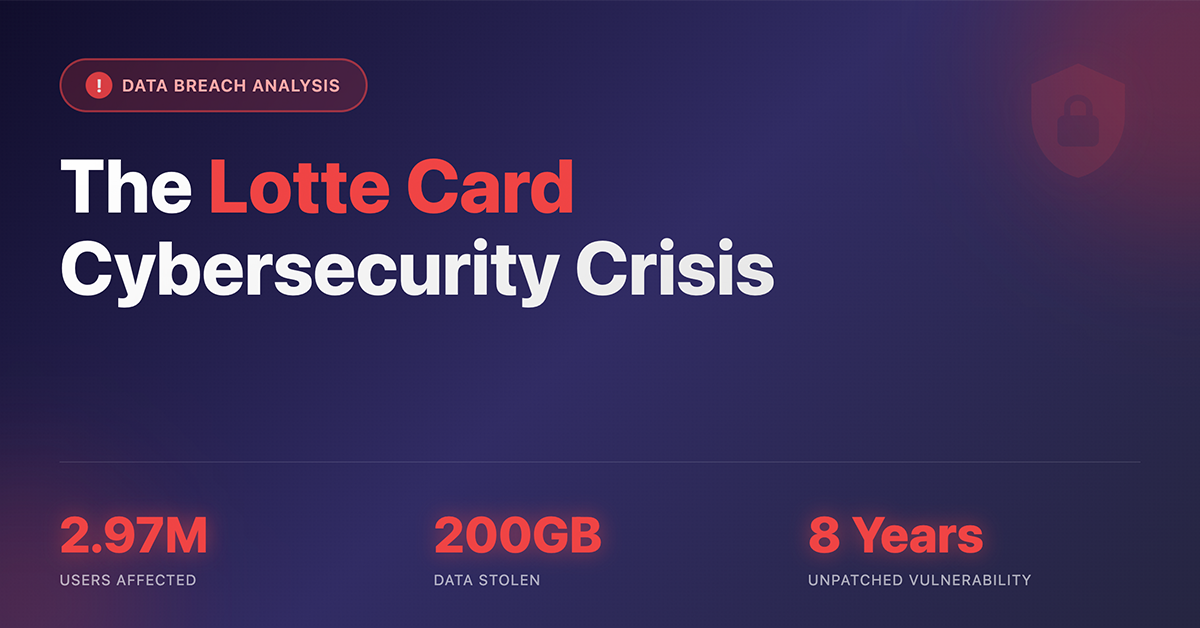
South Korea’s fifth-largest credit card issuer, Lotte Card, suffered a massive data breach in August 2025, exposing the personal information of 2.97 million customers—nearly one-third of its user base. The incident, which went undetected (and unreported) for nearly two weeks, revealed critical security failures including an unpatched vulnerability from 2017, inadequate encryption (only 56% of files), and poor detection capabilities. With potential fines reaching 80 billion won ($57.7 million) and a planned security investment of 110 billion won over five years, this breach serves as a stark reminder of the catastrophic consequences of neglecting cybersecurity fundamentals.
The Anatomy of a Preventable Disaster
In mid-August 2025, hackers infiltrated Lotte Card’s online payment servers in what would become South Korea’s largest financial data breach of the year. The scale of the compromise is staggering: 2.97 million users were affected, with over 200 gigabytes of data stolen—more than 100 times the 1.7 gigabytes initially reported and over 20 times the amount taken in the recent SK Telecom USIM server hack.
The Numbers That Tell the Story
The breach impacted users on multiple levels:
- Total affected customers: 2.97 million (approximately 31% of Lotte Card’s 9.6 million customer base)
- High-risk exposures: 280,000 customers had complete financial credentials compromised, including full card numbers, CVV codes, expiration dates, and resident registration numbers
- Data volume: Over 200 GB of sensitive data exfiltrated
- Files compromised: 2,700 files, with a troubling revelation: only 56% of the leaked files were encrypted
Lotte Card is Korea’s fifth-largest card issuer, serving more than 9.6 million customers and processing about 10 percent of the nation’s daily credit card spending. The breach’s impact on such a critical financial institution sent shockwaves through Korea’s financial sector and raised serious questions about cybersecurity practices across the industry.
A Timeline of Negligence
The breach timeline reveals a disturbing pattern of security failures:
Attackers first scanned the payments server for vulnerabilities on August 12, installed malicious code the next day, and exfiltrated 1.7 gigabytes of data on August 14 and 15. Separately, 200 gigabytes of personal data was stolen between August 15 and 27, with attackers using a proxy-enabled web shell on the payments server to run a file transfer protocol and to repeatedly extract transaction log files.
Perhaps most concerning: Lotte Card did not detect the intrusion until a routine server check on August 26. It finally confirmed the breach on August 31, leaving the system exposed for nearly two weeks.
The Root Cause: An Eight-Year-Old Vulnerability
What makes this breach particularly egregious is its preventability. The exploited vulnerability was first discovered in 2017. Although a security patch was distributed that year, the company said that one server, used for a rarely accessed overseas payment service, was missed during the patching process, leaving a critical hole unaddressed for years.
This is not a sophisticated zero-day exploit or nation-state attack. This was a fundamental failure in patch management and security hygiene that persisted for eight years.
The Cost of Complacency
The financial and reputational damage from this breach will be severe and long-lasting.
Immediate Financial Impact
At a press conference addressing the data breach, Lotte Card announced customer support measures—including card reissuance, annual fee waivers, and interest-free services—which are projected to cost the company several billion won. However, the one-time costs pale in comparison to the long-term investment required: the planned investment of 110 billion won ($79.2 million) over the next five years in information security is expected to pose a medium- to long-term financial burden.
Regulatory Penalties
NICE Investors Service estimated Lotte Card could face fines up to 80 billion won (about $57.7 million) tied to the breach. This aligns with South Korea’s Personal Information Protection Act (PIPA), which empowers regulators to impose significant penalties for data protection violations.
Market and Customer Impact
Analysts expect “a decline in market share due to customer cancellations is expected to be inevitable to some extent.” As of one week after the announcement, over 2,450 card customers had joined an online community for victims, many of whom are considering formal legal action.
The reputational damage extends beyond just customer trust. Credit rating agencies are evaluating potential downgrades, and the incident has intensified scrutiny on MBK Partners, Lotte Card’s majority owner, with lawmakers planning to summon company leadership for parliamentary audits.
What Went Wrong: A Failure of Security Fundamentals
The Lotte Card breach is a textbook case of security failures at multiple levels. Let’s examine the critical mistakes:
1. Inadequate Encryption
The breach affected approximately 2,700 files, of which only 56% were encrypted. This means nearly half of the compromised files containing sensitive customer data were stored in plaintext or with insufficient encryption.
Why this matters: Encryption should be the last line of defense. Even if attackers gain unauthorized access, properly encrypted data remains protected. The fact that 44% of files lacked adequate encryption suggests a systemic failure to implement basic data protection standards.
2. Poor Patch Management
An eight-year-old unpatched vulnerability represents one of the most fundamental failures in cybersecurity. The threat actors exploited an unpatched payment server vulnerability that had remained unfixed since 2017, with one server linked to an overseas payment service that was not updated despite an available fix released within the same year.
Why this matters: Patch management is cybersecurity 101. Organizations must maintain comprehensive asset inventories and ensure all systems—including rarely used servers—receive security updates. The excuse that a server was “rarely accessed” is unacceptable when it handles payment data.
3. Insufficient Monitoring and Detection
The breach went undetected until a routine server check nearly two weeks after the hackers gained access. During this time, attackers had free rein to exfiltrate massive amounts of data.
Why this matters: Modern security requires continuous monitoring, anomaly detection, and automated alerting. A two-week detection gap in a financial institution’s payment infrastructure represents a critical failure in security operations.
4. Centralized, Unsecured Data Storage
The fact that attackers could access and exfiltrate 200 GB of customer data from payment servers suggests that sensitive information was centrally stored without proper access controls or segmentation.
Why this matters: Following the principle of least privilege and data minimization, payment servers should not store more customer data than absolutely necessary. Sensitive information like full card numbers and CVV codes should be tokenized, encrypted, and stored separately from operational systems.
International Standards: What Should Have Been Done
The Lotte Card breach violated multiple internationally recognized security standards and best practices:
PCI DSS Compliance
The Payment Card Industry Data Security Standard (PCI DSS) is the global security standard for organizations that handle credit card information. Key requirements include:
- Encryption of cardholder data: All sensitive authentication data must be encrypted during transmission and storage
- Vulnerability management: Organizations must maintain secure systems by regularly updating and patching software
- Access control: Cardholder data access must be restricted on a need-to-know basis
- Monitoring and testing: Networks must be regularly monitored and tested for vulnerabilities
Lotte Card’s failures—unencrypted files, unpatched servers, and poor monitoring—represent clear violations of PCI DSS requirements.
South Korea’s PIPA Requirements
South Korea’s Personal Information Protection Act mandates that organizations implement appropriate technical, administrative, and physical measures to protect personal information. Specifically, PIPA requires:
- Security measures: Controllers must implement encryption, access controls, and regular security assessments
- Breach notification: Organizations must report breaches promptly to authorities and affected individuals
- Data minimization: Only necessary personal information should be collected and retained
The fact that Lotte Card initially reported only 1.7 GB of data stolen, when the actual figure was over 200 GB, raises questions about the company’s awareness of its own data holdings—a fundamental PIPA requirement.
Government Response and Industry Implications
The Korean government’s response has been swift and comprehensive, signaling a new era of cybersecurity enforcement.
Immediate Regulatory Action
The Ministry of Science and ICT and the Financial Services Commission vowed a sweeping government response to a surge in high-profile cyberattacks that have rattled the nation’s telecommunications and financial sectors. Key measures include:
- Proportional fines: The FSC announced plans to implement fines proportional to the scale of future breaches
- Enhanced authority: Strengthening the authority of chief information security officers
- Mandatory disclosure: Stronger consumer disclosure requirements
- Heavier penalties: Companies that intentionally delay or fail to report cyber intrusions will face significantly heavier penalties. The government will also be empowered to launch investigations based on circumstantial evidence, even in the absence of a formal corporate disclosure
Systemic Industry Changes
The FSC Vice Chairman criticized the financial industry’s lagging cybersecurity posture, noting that “while hacking technologies advance rapidly, many institutions are still treating security investments as avoidable costs”.
This statement cuts to the heart of the problem: cybersecurity is often viewed as a cost center rather than a fundamental business requirement. The Lotte Card breach demonstrates the fallacy of this thinking—the cost of prevention is always less than the cost of remediation.
Strategic Shifts
The Republic of Korea’s National Cybersecurity Strategy released in February 2024 represents an effort to transition from a defensive posture to an offensive posture, mirroring the adoption of “defend forward” in the U.S. Cyber Strategy. This shift acknowledges that passive defense is no longer sufficient in the face of sophisticated, persistent threats.
Key strategic priorities include:
- Public-private coordination: Creating unified data-sharing platforms for national cyber response
- Workforce development: Expanding specialized education programs to address the critical shortage of cybersecurity professionals
- Global cooperation: Strengthening partnerships, particularly with the United States, to combat transnational cyber threats
- Zero trust architecture: Implementing zero-trust security models across government and critical infrastructure
Lessons for the Financial Sector
The Lotte Card breach offers critical lessons for financial institutions worldwide:
1. Security Cannot Be Deferred
The eight-year-old unpatched vulnerability proves that security debt compounds. What seems like a minor oversight—skipping a patch on a “rarely used” server—can become a catastrophic vulnerability. Organizations must maintain rigorous patch management and regularly audit all systems, regardless of perceived usage frequency.
2. Encryption Is Non-Negotiable
With 44% of files lacking adequate encryption, Lotte Card failed one of the most basic security controls. Financial institutions must implement encryption at rest and in transit for all sensitive data, with no exceptions.
3. Assume Breach, Verify Always
The two-week detection gap demonstrates the importance of robust monitoring and detection capabilities. Organizations should assume that breaches will occur and implement layered detection mechanisms, including:
- Continuous network traffic analysis
- Behavioral anomaly detection
- Data loss prevention (DLP) systems
- Security information and event management (SIEM)
- Regular penetration testing
4. Data Minimization Prevents Damage Minimization
The massive 200 GB data theft suggests that Lotte Card was storing far more customer data than necessary on operational servers. Organizations should implement data minimization principles:
- Store only necessary data
- Implement data retention policies
- Use tokenization for sensitive payment information
- Segment networks to limit breach scope
- Regularly audit and purge unnecessary data
5. Transparency Builds Trust, Opacity Destroys It
The discrepancy between initially reported data loss (1.7 GB) and the actual loss (200 GB) damaged credibility. In the event of a breach, transparent and timely communication is essential for maintaining stakeholder trust.
The Human Cost of Data Breaches
Beyond the financial and regulatory implications, it’s crucial to remember the human impact. The compromised data included connection details, resident registration numbers, virtual payment codes, and internal identification numbers. For the 280,000 high-risk individuals whose complete card details were exposed, the consequences include:
- Identity theft risk: Korean resident registration numbers are particularly sensitive and can be used for various forms of identity fraud
- Financial fraud potential: Even with verification requirements, exposed card details create ongoing fraud risks
- Emotional stress: Victims face uncertainty and anxiety about potential misuse of their data
- Time burden: Customers must monitor accounts, replace cards, and potentially deal with fraud resolution
These human costs are difficult to quantify but represent real harm to individuals who trusted Lotte Card with their sensitive financial information.
Looking Forward: Building Cyber Resilience
As South Korea’s financial sector grapples with the implications of this breach, several imperatives emerge:
For Financial Institutions
- Conduct comprehensive security audits: Identify and remediate vulnerabilities before attackers do
- Implement defense in depth: Layer security controls to ensure that failure of one control doesn’t lead to total compromise
- Invest in people: Address the cybersecurity skills gap through training and competitive recruitment
- Embrace modern architectures: Adopt zero-trust models and microsegmentation to limit blast radius
- Test incident response: Regular tabletop exercises and breach simulations prepare organizations for real incidents
For Regulators
- Enforce meaningful standards: Ensure compliance goes beyond checkbox exercises
- Incentivize security: Consider regulatory relief for organizations demonstrating exceptional security practices
- Mandate transparency: Require detailed public reporting of security incidents to drive industry learning
- Support workforce development: Fund cybersecurity education and training programs
For Customers
- Practice digital hygiene: Use unique passwords, enable multi-factor authentication, and monitor accounts regularly
- Understand your rights: Know what protections and remedies are available under PIPA and related laws
- Vote with your wallet: Support organizations that prioritize security and transparency
- Stay informed: Follow security news and take recommended protective actions promptly
Conclusion: A Preventable Crisis
The Lotte Card data breach stands as a stark reminder that cybersecurity is not optional—it’s existential. This was not a sophisticated attack by a nation-state adversary using zero-day exploits. This was preventable. It resulted from fundamental failures in security basics: patch management, encryption, monitoring, and data protection.
As one government official stated, “This is not a time for temporary patches—we are looking to implement fundamental, long-term solutions”. The financial sector must heed this call. Security cannot be treated as a cost to be minimized but rather as a foundational requirement for operating in the digital age.
For Korean financial institutions, the message is clear: implement robust security controls now, or face catastrophic consequences later. For customers, this breach underscores the importance of being vigilant about which organizations handle your sensitive data and how they protect it.
As the dust settles on this breach and regulators finalize their investigations and penalties, one thing is certain: the Korean cybersecurity landscape will never be the same. The question is whether other financial institutions will learn from Lotte Card’s mistakes before they become the next cautionary tale.
Protecting What Matters: SNAPPASS
In an era where data breaches like the Lotte Card incident can expose millions of users and destroy organizational trust overnight, the fundamental question facing businesses is no longer whether to invest in security, but how to implement security that actually works.
At ANDOPEN, we believe that secure password and credential management is the cornerstone of digital security. While large-scale breaches often stem from unpatched systems and poor encryption practices, they are frequently enabled by weak credential management and inadequate access controls. Our mission is to provide organizations and individuals with the tools to implement security best practices from the ground up.
Whether you’re managing personal passwords or enterprise credentials, SNAPPASS offers the security architecture and user experience needed to protect sensitive data in an increasingly hostile digital landscape. Because in cybersecurity, the best defense is getting the fundamentals right—every single time.